

Description
Product Overview
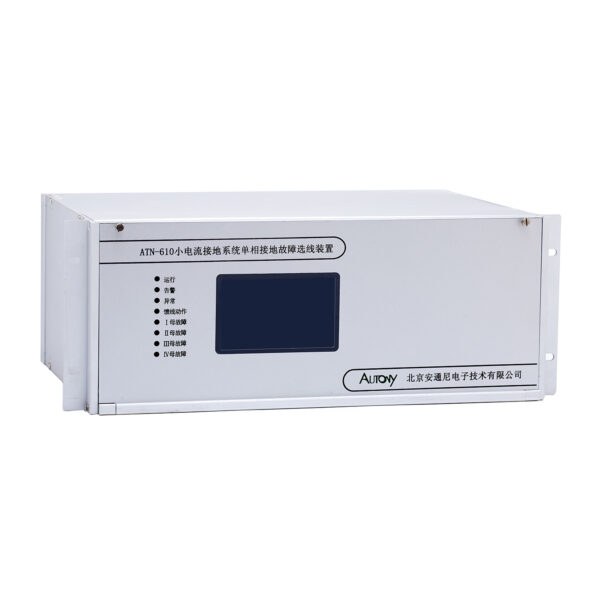
- Small Current Grounding Line Selection relies on the grounding line selecting device to identify single-phase ground faults in power systems with ungrounded neutral, resistor grounded neutral or arc-suppression coil grounded neutral.
- Widely used in power plants, substations, and the power supply systems of large industrial and mining enterprises for single-phase ground fault alarm on lines and busbars, or for line ground fault protection tripping.
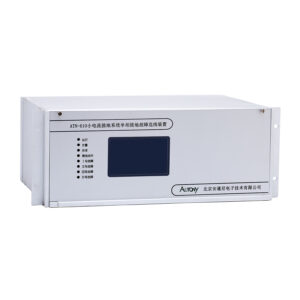
Small Current Grounding Line SelectionFeatures
| Category | Function Item | Core Specification |
|---|---|---|
| Grounding Line Selection Function | Transient Line Selection | Adopts transient route selection method |
| Grounding Line Selection Function | Zero-sequence Directional Line Selection | Adopts zero-sequence overcurrent directional selection method |
| Grounding Line Selection Function | PT Monitoring & Protection | Supports PT de-resonance and PT open-circuit monitoring |
| Grounding Line Selection Function | Reclosing & Acceleration Protection | Equipped with reclosing function and post-reclosing acceleration protection |
| Device Self-Test Function | Hardware Fault Detection | Automatically detects RAM, FLASH, A/D, power loss and other hardware faults |
| Device Self-Test Function | Parameter Validity Check | Automatically verifies setpoints, configuration parameters, coefficients and other settings |
| Communication Function | Communication Interface Support | Supports RS-485, RS-232, Ethernet and IEC 61850 communication modes (specify when ordering) |
| Communication Function | Real-time Data Upload | Can upload busbar voltage, current, grounding information, harmonic data and other real-time operating data |
| Communication Function | Remote Control & Command Reception | Can receive remote control, system synchronization and other control commands from the upper-level system |
| Panel & Operation Function | Human-machine Interface | Equipped with Chinese character LCD display, status indicator lights and keypad for easy monitoring and operation |
| Time Synchronization Function | Network Time Sync | Supports network-based time synchronization via communication channels |
| Time Synchronization Function | IRIG-B Code Sync | Supports IRIG-B code time synchronization |
Rated Electrical Parameters
| Category | Parameter Name | Specification Requirements |
|---|---|---|
| Power Supply Specifications | Rated Operating Voltage | AC/DC 220 V |
| Power Supply Specifications | Permissible Voltage Deviation | -20% ~ +15% |
| Power Supply Specifications | Ripple Factor | ≤5% |
| AC Circuit Specifications | AC Rated Current In | 1 A/5 A |
| AC Circuit Specifications | AC Rated Voltage Un | 100 V |
| AC Circuit Specifications | Rated Operating Frequency | 50 Hz |
| Power Consumption Specifications | DC Power Circuit Power Consumption | ≤25 VA during normal operation; ≤30 VA when the device is activated |
| Power Consumption Specifications | AC Voltage Circuit Power Consumption | ≤1 VA per phase at rated voltage of 100 V |
| Power Consumption Specifications | AC Current Circuit Power Consumption | ≤0.5 VA per phase at rated current of 1 A; ≤1 VA per phase at rated current of 5 A |
Working Principle of Small Current Grounding Line Selection
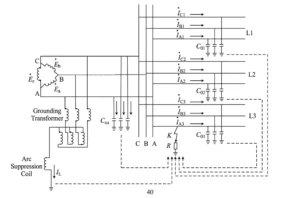
- When a single-phase-to-ground fault occurs in a low-current system, the transient current distribution is characterized by the following: the zero-sequence current in the faulted line has the maximum amplitude and is equal to the sum of the zero-sequence currents in the other, non-faulty lines.
- The Small current grounding line selecting device uses the concept of relative phase—specifically, the direction of the currents relative to one another or the leading and lagging relationships between current and voltage—to determine whether the fault is on the busbar or on the line;
- In the event of a line fault, the system accurately identifies the faulty line. Since the system operates on the principle of relativity, it overcomes the effects of changes in operating modes, ground resistance, and line length, and requires no calibration.
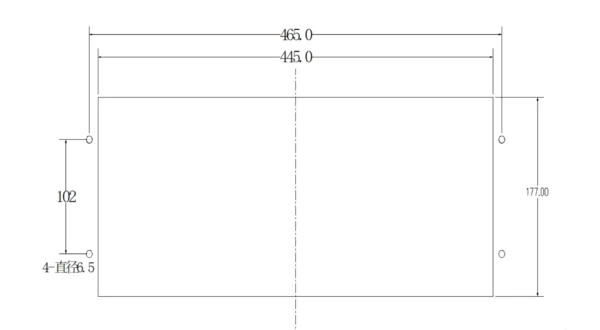
Small current grounding line selecting device Mechanical Installation Dimensions Drawing
- Dimensions: Width × Height × Depth = 484 × 177 × 285 (mm)
- Mounting hole dimensions: 445 × 177 (with 4 mounting holes, each 6.5 mm in diameter)
Small Current Grounding Line Selection Device Fixed-Price Order
| No. | Display Name | Range | Step | Remark |
|---|---|---|---|---|
| 1 | Bus Setting | Bus I setting
Bus II / Bus III / Bus IV are consistent with Bus I |
||
| 1.1 | Name | M001~M004 | 1 | |
| 1.2 | PT Ratio | 1-1000 | — | |
| 1.3 | PT Disconnection | Enable / Disable | — | |
| 1.4 | Outlet Quantity | — | — | |
| 1.5 | Earth Fault Trip | Enable / Disable | — | Enable for trip, Disable for alarm |
| 1.6 | Earth Fault Time Delay | 0.1S | 0.1S | |
| 1.7 | Post Acceleration | Enable / Disable | — | Need to set acceleration time if enabled |
| 1.8 | Earth Fault Voltage | 5.0~100.0V | 0.1V | |
| 1.9 | Rotation Control | Enable / Disable | — | |
| 1.10 | Voltage Threshold | 0.1~100.0V | 0.1V | |
| 1.11 | Voltage Dead Zone | 0.1~100.0V | 0.1V | |
| 1.12 | Rotation Mode | Auto / Fixed | — | Auto rotation mode / Fixed rotation mode |
| 1.13 | Rotation Time Delay | 0.1S | 0.1S | |
| 1.14 | PT Blocking Earth Protection | Enable / Disable | — | Block earth protection when PT disconnection occurs |
| 1.15 | Rotation Voltage | 5.0~100.0V | 0.1V | |
| 1.16 | Corresponding Bus Number | 1-4 | — | |
| 1.17 | Permanent Fault Time Delay | 0~100.0S | 0.1S | |
| 1.18 | Spare | Enable / Disable | — | |
| 1.19 | Current Threshold | 5~100mA | 1mA | |
| 1.20 | Spare | Enable / Disable | — | |
| 1.21 | Current Dead Zone | 5~100mA | 1mA | |
| 1.22 | Spare | Enable / Disable | — | |
| 1.23 | Spare | Enable / Disable | — | |
| 2 | Feeder Setting | Feeder No.01
Other feeders follow the same setting |
||
| 2.1 | Name | Line I B001 | — | |
| 2.2 | Line Type | Overhead / Cable / Station Internal | — | |
| 2.3 | Line Trip Output No. | — | — | |
| 2.4 | CT Ratio | 1~1000 | — | |
| 2.5 | CT Polarity | Positive / Reverse | — | |
| 2.6 | Transient Earth Fault Setting | 5~100mA | 1mA | |
| 2.7 | Earth Delay High Byte | 0~100.0S | 0.1S | |
| 2.8 | Line Earth Fault Trip | Enable / Disable | — | Trip when enabled, alarm when disabled |
| 2.9 | Earth Fault Current | 5~100mA | 1mA | |
| 2.10 | Spare | — | — | |
| 2.11 | Earth Delay Low Byte | 0~100.0S | 0.1S | |
| 2.12 | Rotation Control | Enable / Disable | — | Participate in rotation if enabled |
| 2.13 | Rotation Sequence | 1-4 | — | |
| 2.14 | Line Closing Output No. | — | — | |
| 2.15 | Auto-reclosing Enable | 0 / 1 | — | |
| 2.16 | Protection Trigger Reclosing | 0 / 1 | — | |
| 2.17 | Reclosing Time Delay | 0~100.0S | 0.1S | |
| 3 | Spare Setting | — | — | |
| 4 | Resonance Threshold Setting | |||
| 4.1 | Spare | 5.0~100.0V | 0.1V | |
| 4.2 | Spare | 5.0~100.0V | 0.1V | |
| 4.3 | 17Hz Resonance Threshold | 5.0~100.0V | 0.1V | |
| 4.4 | 25Hz Resonance Threshold | 5.0~100.0V | 0.1V | |
| 4.5 | 50Hz Resonance Threshold | 5.0~100.0V | 0.1V | |
| 4.6 | 150Hz Resonance Threshold | 5.0~100.0V | 0.1V | |
| 4.7 | 250Hz Resonance Threshold | 5.0~100.0V | 0.1V | |
| 4.8 | Overvoltage Threshold | 5.0~100.0V | 0.1V | |
| 5 | Binary Input Setting | |||
| 5.1 | Debounce Time Delay | 10ms~9999ms | — | Factory default: 20ms |
| Remote Signal Polarity 1~48 | 0 or 1 | — | ||
| 6 | LCD Setting | |||
| 6.1 | Fault Lamp Reset Mode | Auto / Manual | — | |
| 6.2 | Fault Lamp Return Time | 0~120S | 1s |
FAQ
Q:What are the common technical parameters for selecting a Small Current Grounding Line Selection device for low-current ground fault line identification?
A:To summarize, when choosing a Small Current Grounding Line Selection & low-current ground fault detection device, key reference parameters are as follows: the quantity of control circuits (decided by on-site conditions), availability of trip function and fault recording function.
xiao zhang –
This feeder selector accurately picks faulty feeder under small-current earthing system. High anti-interference, adjustable sensitivity and standard communication, widely used in 6~35kV neutral ungrounded distribution substations.
Jack –
Compact and lightweight — shipping and handling are hassle-free.