

Description
Product Overview
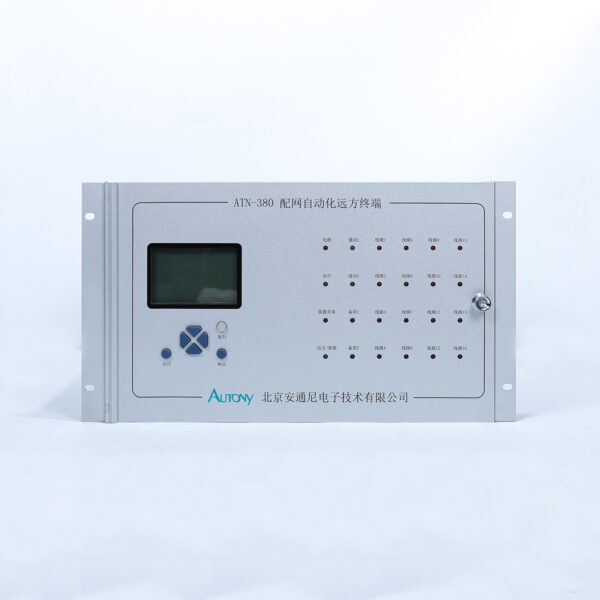
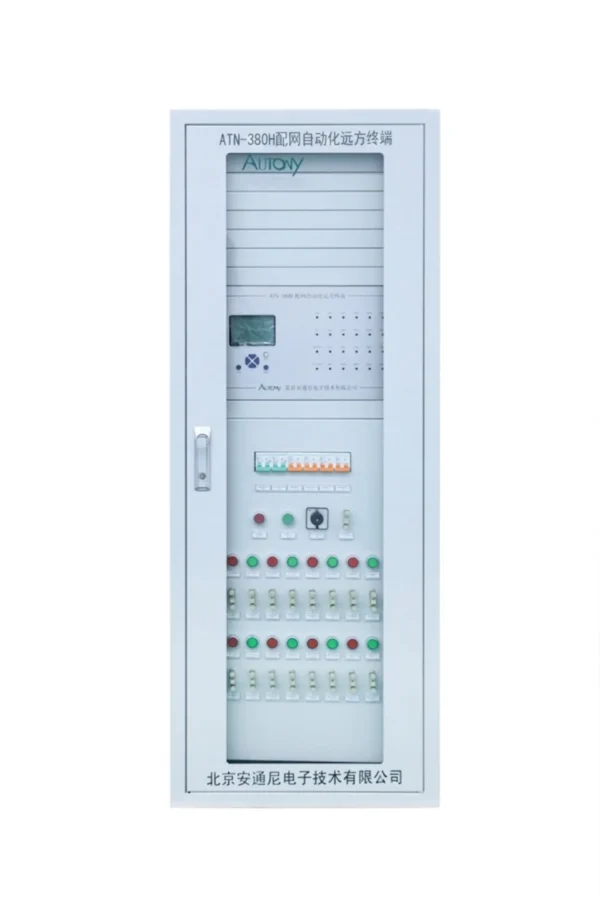
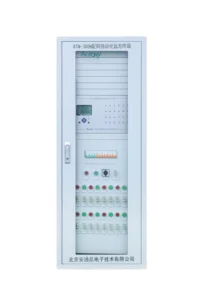
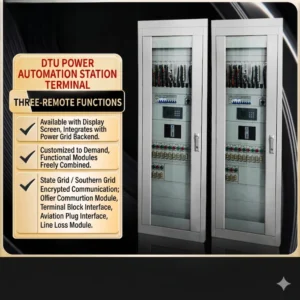
- DTU-380H Distribution Terminal Unit integrates protection, measurement, control, and communication functions into a single unit, offering high integration and flexible configuration.It is a multifunctional device
- Widely used in ring main units, small switching stations, and prefabricated substations, this system can be integrated with distribution network automation master stations and sub-station systems to collect and control power data from multiple lines, detect faults, locate and isolate fault zones, and restore power to non-faulty areas, thereby enhancing power supply reliability.
Feature Overview
Fault Detection Function
Key Troubleshooting Features
| No. | Function Description |
|---|---|
| 1 | Three-stage overcurrent protection trip function: trip and alarm are optional |
| 2 | Overload protection: trip and alarm are optional |
| 3 | Single-phase earth fault protection: trips for earth fault |
| 4 | Overvoltage protection function: alarm |
| 5 | Undervoltage protection function: alarm |
| 6 | PT disconnection detection: single-phase and three-phase PT disconnection |
| 7 | Three times auto-reclosing; when reclosing onto faulty line, accelerated tripping operates |
| 8 | Fault recording: support fault waveform recording function |
| 9 | Supports dual AC power supply with automatic dual power switching function |
| 10 | Equipped with backup battery power supply function |
Fault Diagnosis Function
- Based on the magnitude of the detected current and the preset thresholds, the terminal can identify fault currents, quickly calculate their magnitude, and proactively report fault information and characteristics to the master station or sub-station (with priority given to status changes) to facilitate fault isolation.
Remote Out-of-Limit Detection Function
- Current out-of-limit detection; voltage out-of-limit detection; zero-sequence voltage out-of-limit detection; zero-sequence current out-of-limit detection. Based on the measured current and voltage values and the configured thresholds, the terminal actively reports any out-of-limit events to the master station or substation.
Communication Features
| Category | Item | Specification |
|---|---|---|
| Standard Communication Port Configuration | Ethernet Port | Standard configuration: 2 ports; supports 10/100BASE-T auto-negotiation Ethernet communication |
| Standard Communication Port Configuration | Serial Communication Port | Standard configuration: 4 ports; supports RS-485/RS-232 communication |
| Supported Communication Modes | Fiber-optic Network Communication | Supported (requires installation of a fiber-optic switch) |
| Supported Communication Modes | Power Line Communication | Supported |
| Supported Communication Modes | Wireless Communication (GPRS) | Supported; communicates with the master station or mobile phones of relevant personnel via a GPRS/CDMA smart wireless communication module |
| Protocol & Configuration Features | Multi-protocol Flexible Configuration | Supports flexible configuration of multiple communication protocols |
| Protocol & Configuration Features | Multi-station Communication Capability | Multiple communication ports enable simultaneous communication with multiple master stations and slave stations |
| Protocol & Configuration Features | Standard Protocol Compatibility | Supports communication with master stations and slave stations via mainstream protocols including IEC 60870-5-101 and IEC 60870-5-104 |
Remote control functionality
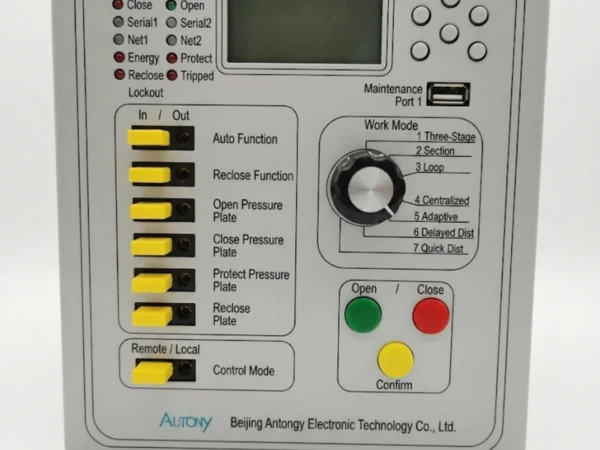
- The terminal receives and executes remote control commands from the master station or sub-station to open and close the switch.
- Equipped with a remote/local selector switch: The selector switch controls access permissions, allowing the switch to be opened and closed locally.
- Hardware and software measures to prevent false triggering, ensuring the reliability of control operations;
Telemetry capabilities
- Telemetry data acquisition: Includes analog signals such as Ua, Ub, Uc, Ia, Ib, Ic, F, P, Q, COS, I0, and U0.
- Measure the DC voltage of the battery, as well as the 2nd through 13th harmonic components of the current and voltage.
Remote monitoring functionality
- Collect remote signal status changes and fault signals, and transmit status data to the master station or substation; store Sequence of Events (SOE). The remote signal resolution is less than 2 ms. Remote signal input signals are fed into the remote signal acquisition module via dry contacts for processing. The software filtering time is configurable, ensuring that remote signal status changes are generated only when stable remote signal actions occur, thereby reducing false alarms.
FAQ
Q:In what types of projects are distribution network automation control terminals typically used, and what signals and data do they primarily collect?
A:DTU-380H Distribution Terminal Unit is primarily used in power distribution projects, where it collects data from high-voltage switchgear—including voltage, current, and switch position signals—and transmits this data to the distribution network automation center.
Q:Can the power distribution terminal unit communicate with the DC power supply panel for relay protection or with smart meters?
A:The power distribution terminal unit is equipped with communication capabilities, featuring both Ethernet and serial ports, and can communicate directly with secondary equipment that supports communication.
xiao zhang –
This compact DTU collects switchgear voltage & current data, executes remote opening/closing control for distribution feeders. With fault detection and multi-protocol communication, widely deployed in overhead line switches and box substations.
Jack –
Instantaneous overcurrent protection responds exactly as specified.