Failing to design and develop cleaning processes at the drug‑research stage
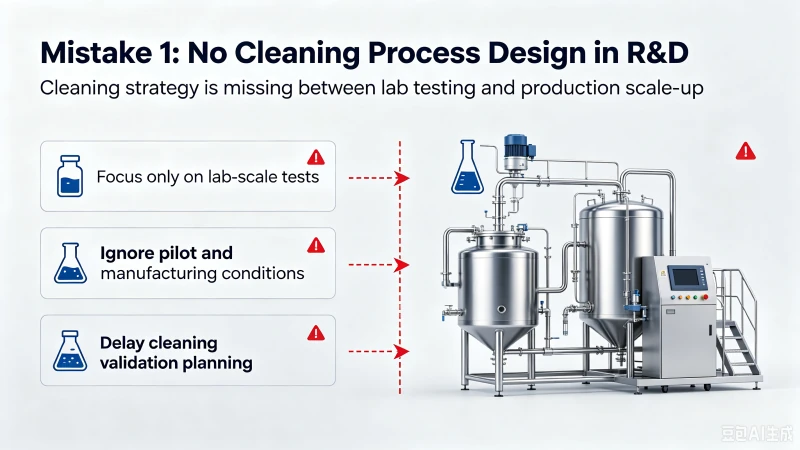
When teams carry out drug research, they often focus only on lab‑scale work. They ignore later pilot tests and full‑size production. So they skip the design and development of cleaning processes for Pharmaceutical Equipment Cleaning.
For example, small lab‑level equipment may use organic solvents for cleaning. When you expand to large‑scale workshops, your factory may not support organic‑solvent cleaning. You then have to build a brand‑new cleaning process from scratch. You can avoid this trouble if you plan cleaning work early in research. This creates smoother links between lab development and real production, and helps your company work more efficiently. China released the Guidelines for Quality Risk Management of Shared Production of Pharmaceuticals in March 2023. This document clearly requires companies to develop cleaning processes during the research phase.
Pharmaceutical Equipment Cleaning :Picking and using the wrong cleaning agents
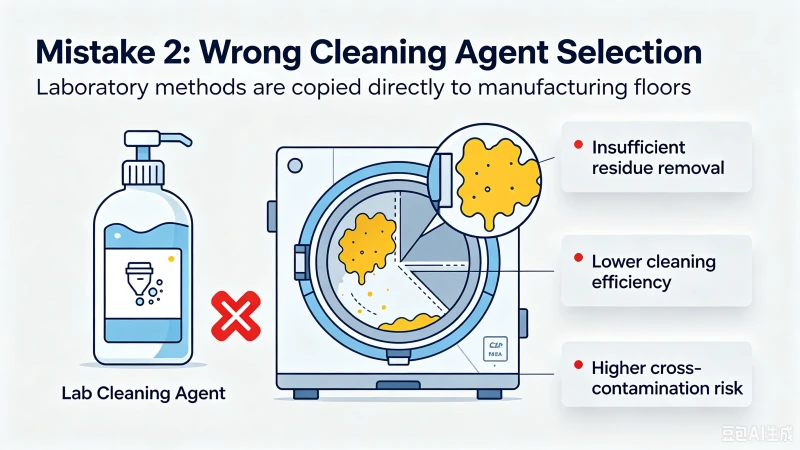
If you do not think about production‑site cleaning during research, you may keep using the same cleaning agents and cleaning methods from your lab work after scale‑up. These choices may lower cleaning efficiency and cannot fully remove target residues on production equipment.
Sometimes research teams use manual cleaning in labs. Factories may copy this method for mass production. Manual cleaning becomes slow and complicated. If multiple products share one set of equipment, cross‑contamination may take place.
In competitive markets, wasted time means lost profits. Poor cleaning slows down your whole production and puts your business at a disadvantage. Choosing proper cleaning agents matters a lot for pharmaceutical‑equipment cleaning. You can use CCPD® to find the best cleaning parameters and meet your equipment cleaning requirements.
Following incorrect cleaning procedures
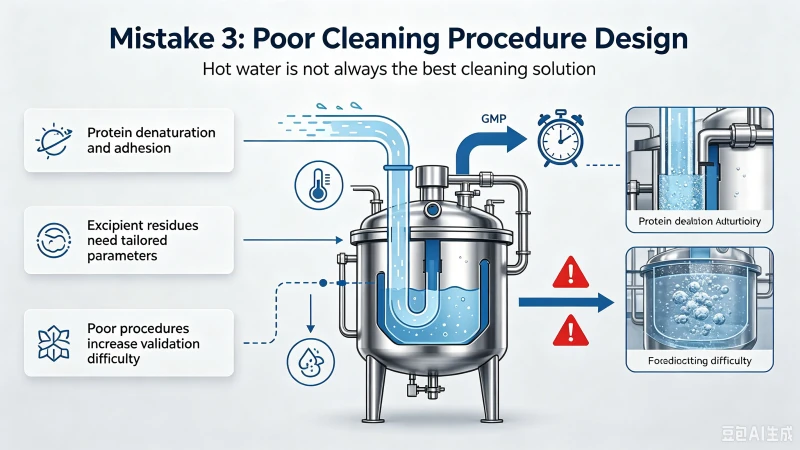
If you start with wrong cleaning agents, you will never get ideal cleaning results within the shortest possible time. Your work stays inefficient, and cleaning validation becomes much harder.
Jingchuan provides professional cleaning solutions with rich field experience and many real‑world cases. Many people believe hot water always gives better cleaning results. This idea is not always true. For protein‑based materials, high‑temperature water makes proteins change their structure and stick tightly to equipment surfaces. They become harder to wash away. For some solid‑dosage excipients, warm or even cold water works better.
R&D staff at pharmaceutical factories need to understand that cleaning challenges change across different production stages. You must select suitable cleaning agents and match them with optimized cleaning procedures to solve complex cleaning problems.
4. Ignoring the influence of excipients
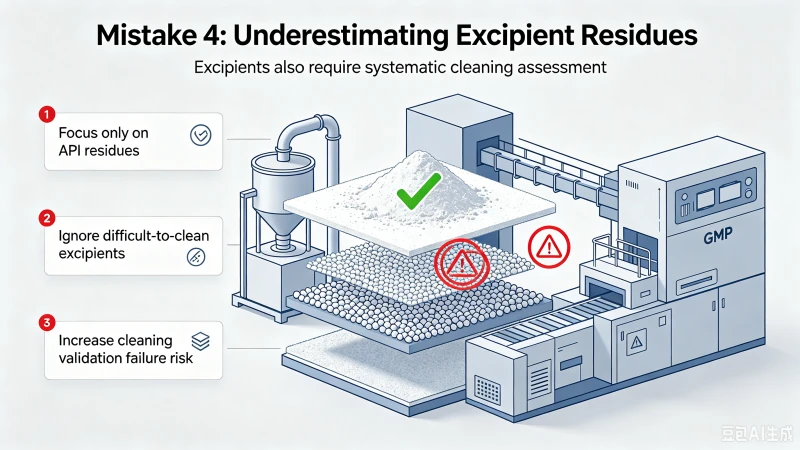
Many teams only pay attention to API (active pharmaceutical ingredient) and forget excipients added in production for Pharmaceutical Equipment Cleaning. This mistake also causes cleaning‑validation failures. It makes sense that companies focus on API because official rules give clear guidance for API. Even though excipients are inactive materials, you still need to evaluate them for cleaning. Some excipients create big cleaning challenges.
Before you expand production capacity, you should work out your best cleaning process. The Jingchuan JClean series are water‑based cleaners with mixed formulas. They help customers solve tough cleaning problems and reach final cleaning goals.
Incomplete cleaning evaluation in lab‑scale production
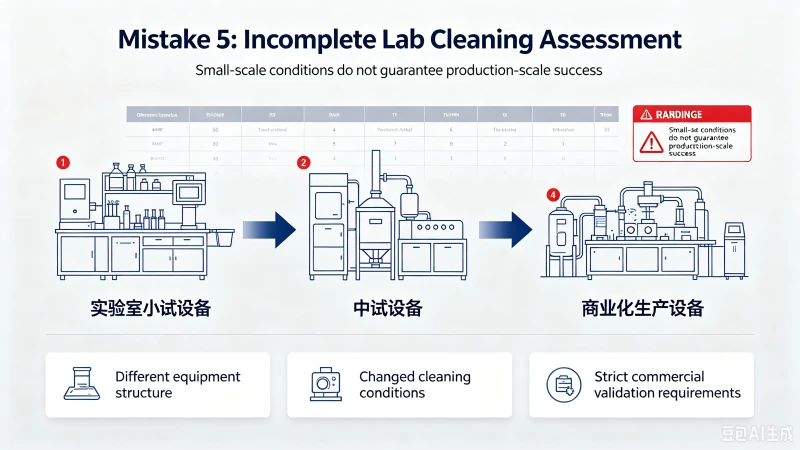
Companies usually test cleaning agents and cleaning steps in small lab batches. Yet cleaning conditions for pilot‑scale or commercial production often differ from lab settings. Small changes may make your cleaning validation fail. You need to fully assess all factors that affect cleaning during lab‑scale work to prevent such risks.
First, list every factor that may influence Pharmaceutical Equipment Cleaning. Use this list to judge possible problems in pilot‑scale and commercial‑scale cleaning. Ask practical questions: Does pilot or commercial equipment share the same structure as lab equipment? Can you use the same cleaning methods from lab to larger batches? Can you keep the same cleaning agents?
You also need to think about regulatory differences. Lab‑scale work puts more focus on production processes to keep product consistency. Commercial production requires stable production plus verified cleaning workflows. You must complete validation for both production and cleaning. Full evaluation at the lab stage supports smooth transitions: from small‑batch trials to pilot tests, and then to full commercial manufacturing. Every step connects seamlessly.
In short, pharmaceutical companies face many challenges across the whole drug lifecycle. Meeting official cleaning‑validation requirements for Pharmaceutical Equipment Cleaning ranks among the most important work. Cleaning rules protect end users and manufacturers, and keep your equipment running normally. Jingchuan holds this view: cleaning is the first step of production, not the last step. When you follow this idea, both R&D and production equipment support safe, clean and contamination‑free manufacturing.
Setting residue limits only for active substances and ignoring cleaner residue limits
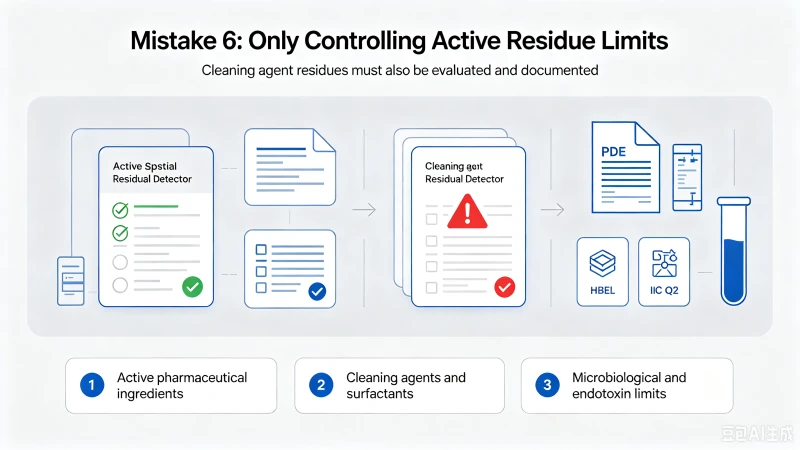
Some companies set acceptable residue limits for active substances following official requirements, but overlook acceptable residue limits for cleaning agents.
The Guidelines for Quality Risk Management of Shared Production of Pharmaceuticals, published in March 2023, states clearly: cleaning validation supplies documented proof that cleaning processes remove contaminants such as active substances, cleaning agents, microbes and endotoxins down to acceptable levels.
How do you bring cleaner residues to acceptable levels?
Think over three key points.
First, pick water‑soluble cleaning agents that rinse away easily with water.
Second, you need reliable test methods to measure leftover cleaner. For mixed‑formula cleaners, build special test methods just like you do for drugs. Complete method‑validation work following guides such as ICH Q2.
Third, set acceptable residue limits for cleaners.
The above‑mentioned guideline suggests calculating limits based on the cleaner’s PDE value. This method works better than older rules such as the 1/1000 minimum daily dose or the 10‑ppm standard.
The document writes: “Compared with traditional limit‑setting methods (e.g. 1/1000 minimum daily therapeutic dose, 10 ppm method), health‑based exposure limit (HBEL) acceptance criteria such as PDE values offer more scientific advantages for assessing cleaning‑residue data. You can build residue standards for active substances, cleaning agents, degraded or denatured active substances, protein fragments and other materials.”